

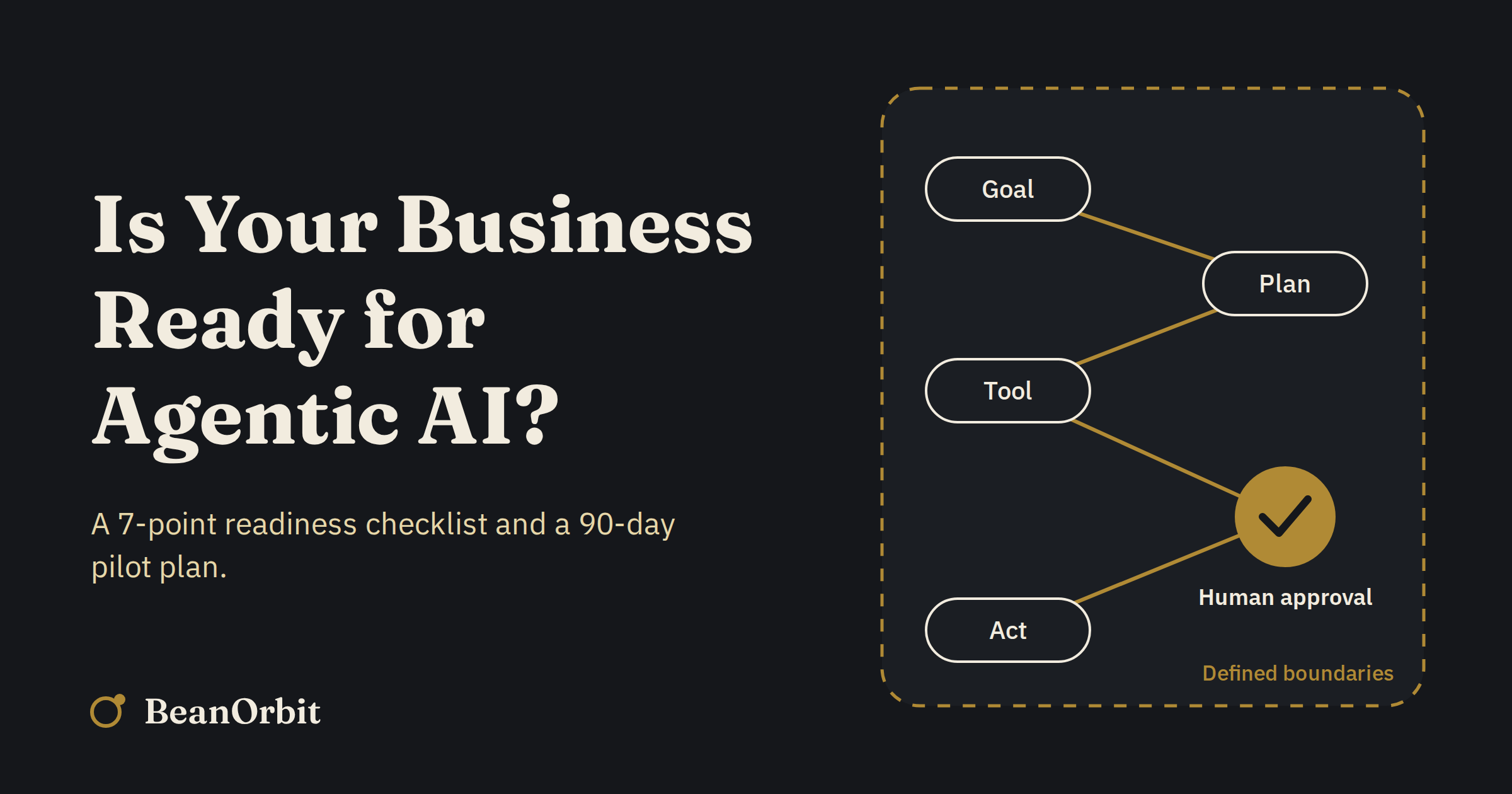
Is Your Business Ready for Agentic AI?
Imagine your operations team spending Monday morning responding to customer enquiries, following up on leads, verifying invoices and compiling reports. These tasks are essential, but managing them manually takes time away from strategic work.
Now imagine an AI system that can retrieve information, execute approved actions and escalate exceptions with minimal human intervention.
This is the potential of agentic AI for business. Unlike conventional AI tools that primarily generate content or answer questions, AI agents can plan tasks, interact with connected systems and execute multi-step workflows within defined boundaries.
However, successful adoption requires more than the right technology. Businesses need reliable data, streamlined processes, suitable integrations and effective oversight.
So, is your business ready? Explore the key use cases, potential risks and seven-point readiness checklist to identify your next steps.
What Is Agentic AI
Agentic AI refers to AI systems that work toward defined goals by planning tasks, using connected tools, and taking action with limited human intervention. Unlike traditional automation, which follows predefined rules, AI agents can adapt to changing information and choose from permitted actions. Think of a chatbot as a receptionist who answers questions, while an AI agent acts like an operations assistant who retrieves records, updates systems and completes tasks within defined boundaries.
Agentic AI vs Generative AI
Dimension | Generative AI | Agentic AI |
Input | A prompt or question or supplied context | A goal, instruction available data and operational context. |
Output | Generated text, images, code summaries or other content | Completed action,coordinated workflow or decisions that move towards a goal. |
Autonomy | Usually it depends on a user’s request. | Can plan and execute multiple steps within defined boundaries. |
These categories are not mutually exclusive. An agentic system may use a generative AI model to interpret information, draft responses or decide which permitted tool to call. In agentic AI vs generative AI, the key distinction is not whether a system uses AI. It is whether the system can move beyond generating an answer to taking controlled action towards a business objective.
Why Businesses Are Paying Attention to Agentic AI
Businesses are exploring AI agents because operational efficiency increasingly depends on how effectively teams coordinate information, systems and decisions. Three pressures make this especially relevant.
- Rising operational costs
As transaction volumes grow, repetitive administrative work can increase the cost of serving each customer. AI agents can help to reduce manual effort in suitable workflows, allowing employees to focus on exceptions, customer relationships and strategic decisions.
- Higher customer expectations
Customers increasingly expect timely responses, consistent updates and fewer handoffs. AI agents can help retrieve relevant information, categorise requests and progress routine cases, while escalating sensitive or complex situations to human staff.
- Growing pressure to modernise operations
Competitors are exploring AI-assisted workflows to improve responsiveness and operational capacity. Businesses that evaluate these technologies early can identify practical opportunities, establish governance standards and build internal expertise before expanding adoption.
The potential is significant, but interpret the evidence carefully. In its 2024 Work Trend Index, Microsoft and LinkedIn reported that 75% of knowledge workers surveyed were using AI at work. This finding reflects AI adoption broadly, not agentic AI adoption specifically.
https://www.microsoft.com/en-us/worklab/work-trend-index/ai-at-work-is-here-now-comes-the-hard-part
For businesses, the practical question is not whether AI is attracting attention. It is whether a particular workflow is suitable for controlled automation and whether the expected benefits justify the implementation effort.
To explore how these systems can be designed for specific business functions, read Beanorbit’s guide to vertical AI agents.
The 7-Point Agentic AI Readiness Checklist
Before investing in AI agents for business automation, assess whether your organisation has the operational foundations required to deploy it responsibly. Use the following checklist to identify strengths and gaps.
1. Your processes are documented and repeatable
AI agents need a clear understanding of the task, the expected outcome and the conditions under which they should stop or escalate. Documented workflows make these requirements easier to translate into reliable instructions.
Red flag: Employees follow different informal procedures for the same task and important steps exist only in their experience.
2. Your data is clean, accessible and structured
An agent is only as useful as the information it can access and interpret. Consistent records, clear data ownership and reliable information sources reduce the risk of inaccurate outputs and inappropriate actions.
Red flag: Customer records contain duplicates, critical information is scattered across spreadsheets, or teams regularly work with outdated data.
3. Your tools support APIs or integrations
AI agents need controlled access to the systems where work happens, such as CRM platforms, ticketing tools, accounting software and internal databases. APIs and supported integrations provide a structured way to retrieve information and execute authorised actions.
Red flag: Employees rely on repeated manual copying between disconnected systems, with no reliable integration options.
4. You have identified one high-impact, low-risk use case
Start with a workflow that occurs frequently, consumes measurable staff time and has clear success criteria. Routine lead classification, internal knowledge retrieval or document categorisation may be better starting points than autonomous financial approvals.
Red flag: Your AI initiative is defined by a broad ambition to automate everything rather than a specific operational problem.
5. Someone owns the AI initiative internally
A designated business owner should define the objective, coordinate stakeholders, monitor performance and resolve operational issues. Technical implementation alone cannot establish whether an AI agent is delivering business value.
Red flag: Nobody is accountable for the pilot’s outcomes, access decisions or ongoing maintenance.
6. You have a human-in-the-loop approval plan
Not every action should be autonomous. Establish which tasks an agent can complete independently, which require approval and which must always be handled by an authorised person.
Red flag: The system can send external communications, change important records or initiate financial transactions without appropriate controls.
7. Your team is open to change and trained for it
Employees need to understand how the agent works, where its limitations lie and when human judgement is necessary. Involving the people who perform the workflow can also uncover exceptions that are missing from formal documentation.
Red flag: Staff are excluded from implementation discussions, concerned about unclear accountability or unsure how to report errors.
How ready is your business?
Count the number of checklist items your organisation can confidently satisfy.
- 5-7 points: Ready to pilot. Your foundations may support a controlled pilot, although unresolved risks and critical dependencies must still be addressed.
- 3-4 points: Strengthen the foundations. Improve data quality, workflow documentation, ownership or integration capabilities before introducing more autonomy.
- 0-2 points: Start with process mapping. Establish consistent workflows and measurable objectives before investing in an AI agent.
This score is an initial screening tool, not a formal technical or security assessment. A high score does not automatically make a high-risk use case suitable for autonomous execution.
Where Agentic AI Delivers Value First
The strongest initial use cases tend to combine repetitive work, accessible information, clear business rules and outcomes that can be measured. The following examples illustrate where AI agents may fit into existing operations.
Customer support triage and resolution
In place of requiring an employee to read every incoming ticket, identify its category and search for the relevant account, an agent can classify the request, retrieve approved knowledge and prepare a response or route the case to the right team.
For simple requests, it may complete the permitted steps. Complaints, ambiguous requests and sensitive cases should be escalated according to defined rules.
Explore BeanOrbit’s AI chatbot solutions to understand how conversational interfaces can support customer interactions.
Lead qualification and follow-ups
Rather than manually reviewing every enquiry and updating lead records, an agent can assess incoming information against predefined qualification criteria, retrieve relevant CRM details and prepare a personalised follow-up.
Sales representatives can review priority leads, approve communications where required and focus their attention on prospects with stronger buying signals.
Invoice and document processing
Instead of manually extracting information from every invoice, an agent can identify relevant fields, compare them against purchase orders, flag discrepancies and route documents for approval.
Human review remains important for mismatched amounts, missing information and transactions that require financial authorisation.
Internal reporting and business intelligence
Instead of collecting updates from multiple systems and compiling recurring reports manually, an agent can retrieve approved data, identify significant changes and prepare a summary for management review.
The workflow should preserve source references, distinguish verified figures from interpretations and flag missing data rather than inventing explanations.
IT and DevOps monitoring
By automating engineers to investigate every alert from the beginning, an agent can gather relevant logs, check approved diagnostic sources, summarise likely causes and recommend the next troubleshooting step.
Low-risk diagnostic actions may be automated under defined conditions. Production changes, destructive commands and security-sensitive operations should remain subject to appropriate safeguards.
For broader workflow integration, explore BeanOrbit’s AI automation services.
The right use case depends on your systems, operational constraints and risk tolerance. An agent that performs well in a controlled test may still struggle with incomplete records, unusual exceptions or changing business rules. Validate performance against real workflows before expanding its responsibilities.
Risks to Plan For and How to Manage Them
Agentic AI can do more than generate content. It can also take actions, making proper oversight essential to prevent operational errors, data exposure and unintended decisions.
Wrong Actions and Unreliable Decisions
Agents may misinterpret instructions or act on incomplete information, potentially affecting business operations or customer records.
Practical safeguard: Validate outputs, require approval for high-impact actions and define clear escalation rules.
Data Privacy and Unauthorised Access
Agents may handle sensitive business or customer data, creating risks when access permissions are poorly managed.
Practical safeguard: Apply least-privilege access, use secure integrations and establish clear data protection and retention policies.
Over-Automation and Loss of Human Oversight
Automating every step can lead to errors when tasks require human judgement or involve unexpected situations.
Practical safeguard: Set clear autonomy limits, maintain audit logs and provide a reliable way to escalate issues or pause the agent.
Regularly test for inaccurate outputs, prompt injection and unauthorised actions. Review permissions and performance whenever workflows or connected systems change.
Your First 90 Days: From Readiness Assessment to Pilot
A phased implementation helps organisations test assumptions, identify operational gaps and establish evidence before expanding automation.
Days 1-30: Assess and prioritise
Map existing workflows, identify repetitive tasks and establish baseline performance. Select one high-impact, low-risk use case, define success metrics and document data requirements, integration dependencies and approval boundaries.
Days 31-60: Build and validate
Configure the agent, connect approved systems and test representative scenarios including unusual inputs and failure conditions. Run the workflow in a controlled environment with human review. Record errors, escalations, processing times and employee feedback.
Days 61-90: Measure and decide
Compare pilot results against the original baseline. Evaluate output accuracy, exception rates, operating costs, reliability and business impact. Resolve critical issues before expanding the agent’s permissions or applying the approach to additional workflows.
At the end of 90 days, the goal is to make an evidence-based decision: improve the pilot, expand it under controlled conditions or discontinue it if the results do not justify the investment.
Conclusion
Agentic AI for business is changing how organisations manage workflows, automate tasks and make operational decisions. Successful adoption depends on reliable data, streamlined processes, suitable integrations and effective oversight.
Before investing, assess your readiness, identify a measurable use case and validate its performance through a controlled pilot. Expand automation only when the results justify it.
For businesses, partnering with an experienced AI automation company in Kerala can help to identify suitable use cases and develop a practical adoption roadmap.
Not sure where to start? Talk to BeanOrbit’s team to evaluate your business needs and explore our AI automation services or contact us to discuss your requirements.
Frequently Asked Questions
●What is agentic AI in simple terms?
Agentic AI is AI designed to work towards a goal by planning tasks, using connected tools and carrying out authorised actions with limited human intervention.
●How is agentic AI different from a chatbot?
A conventional chatbot primarily responds to questions, while an AI agent can also interact with business systems, coordinate tasks and execute permitted actions.
●Is agentic AI safe for small businesses?
It can be suitable when deployed with restricted permissions, secure data access, appropriate human oversight and continuous monitoring. Starting with a well-defined, low-risk workflow helps businesses manage implementation risks.
●How much does it cost to implement agentic AI?
Costs depend on workflow complexity, integration requirements, AI model usage, security controls and ongoing maintenance. A focused pilot helps establish realistic costs and potential business value before a larger investment.

Ajaymon K S
Ajay Mon K S is the Founder & CEO of BeanOrbit International LLP, an AI-driven software company. With over seven years of experience, he leads the company's vision and business growth.