

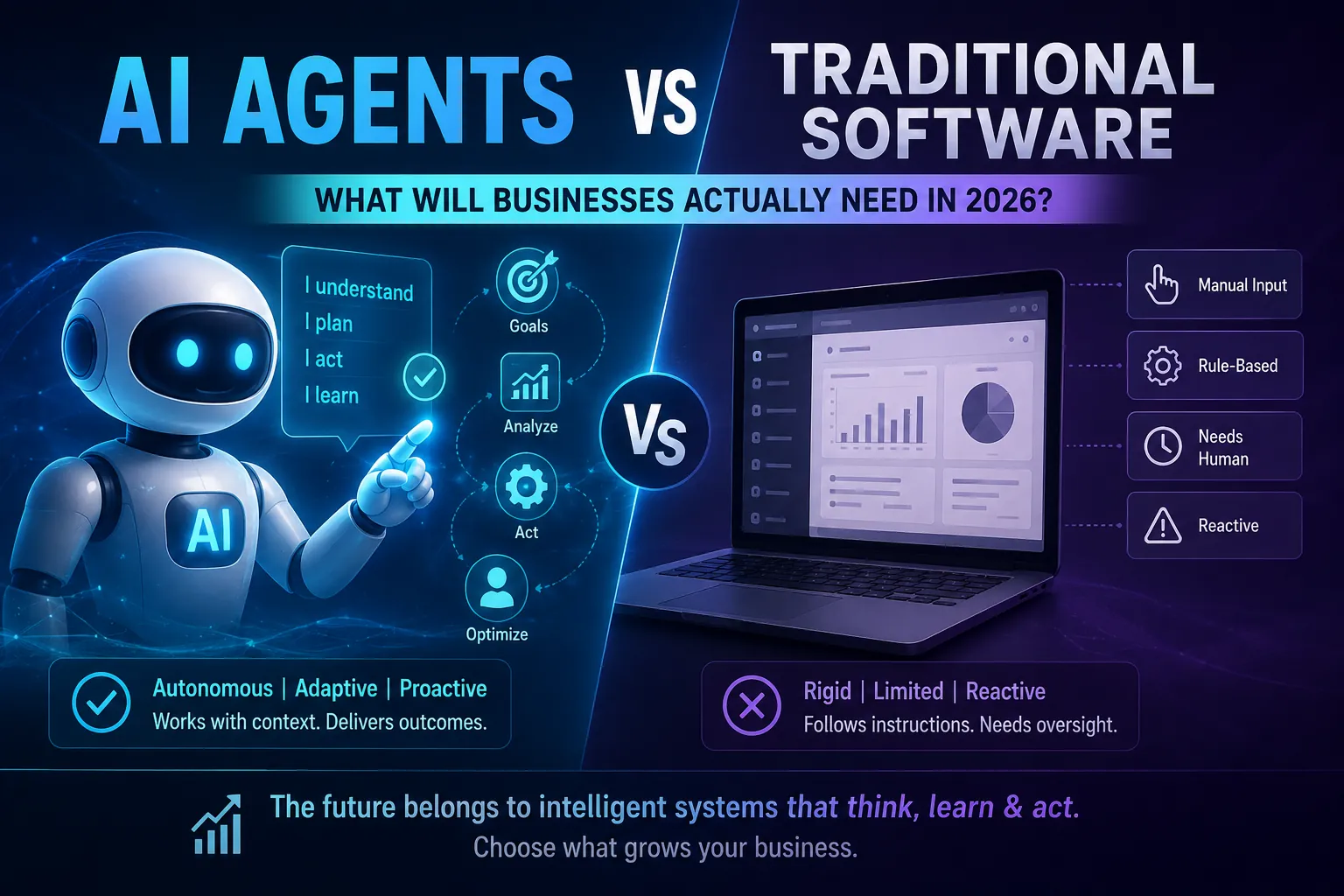
Imagine your customer submits a support request at midnight. Your CRM stores their history, your ERP tracks the order, but nothing happens until someone logs in the next morning. This is the gap many businesses are trying to close in 2026.
Enterprise software is entering a new era. Gartner predicts that by the end of 2026, 40% of enterprise applications will include task-specific AI agents, up from less than 5% in 2025.
This represents a transition from software that simply records information to systems that can understand context and drive action.
As organisations scale, manual workflows become a barrier to speed and efficiency. AI agents for business address this challenge by connecting data across systems, automating complex tasks and supporting faster decision-making, all while enhancing the software businesses already rely on. Rather than viewing these technologies as competitors, businesses should understand where each creates the greatest value. That’s exactly what we will explore in this article.
What Are AI Agents?
AI agents are intelligent software systems that understand goals, make decisions and complete tasks with minimal human intervention. Unlike traditional software, they don’t just follow predefined rules. They analyse context, plan actions and work across multiple applications to achieve a specific outcome.
How AI Agents Work
- Goal-Oriented — AI agents focus on achieving a business objective rather than simply executing commands.
- Memory — They retain relevant context from previous interactions to improve accuracy and continuity.
- Reasoning — They analyse available information, evaluate possible actions and choose the most suitable approach.
- Tool Usage — They connect with CRMs, ERPs, databases, APIs, emails and other business applications to complete tasks.
- Autonomous Decision-Making — They can execute approved workflows with minimal human intervention while adapting to changing conditions.
What Is Traditional Business Software?
Traditional business software is designed to manage structured data, standardise business processes and execute predefined rules. It follows fixed workflows, automates repetitive tasks and relies on human input to initiate actions and make decisions, ensuring consistency, accuracy and control across everyday business operations.
Common Types of Traditional Business Software
- ERP: Manages finance, procurement, inventory and operations.
- CRM: Stores customer information and manages sales activities.
- Accounting Software: Tracks financial transactions and reporting.
- Inventory Management: Monitors stock levels, orders and warehouse operations.
- HRMS: Manages employee records, payroll and attendance.
- Custom Software: Supports unique business requirements and internal workflows.
Popular Enterprise Platforms
Some of the most widely used traditional business platforms include:
- SAP
- Salesforce
- Zoho
- Microsoft Dynamics
- Oracle
- Custom ERP solutions
These systems remain the backbone of business operations because they provide reliable data management, compliance and operational consistency.
AI Agents vs Traditional Software: Key Differences
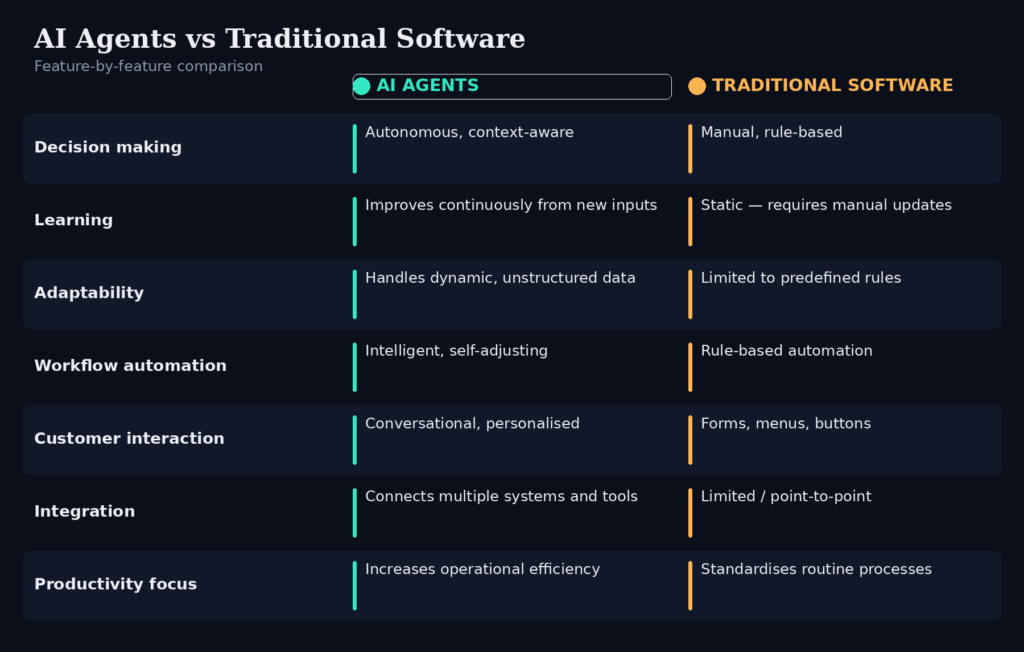
Understanding the differences between AI agents vs traditional software helps businesses to choose the right technology to improve efficiency, automate workflows and support long-term growth.
Why Businesses Are Investing in AI Agents in 2026
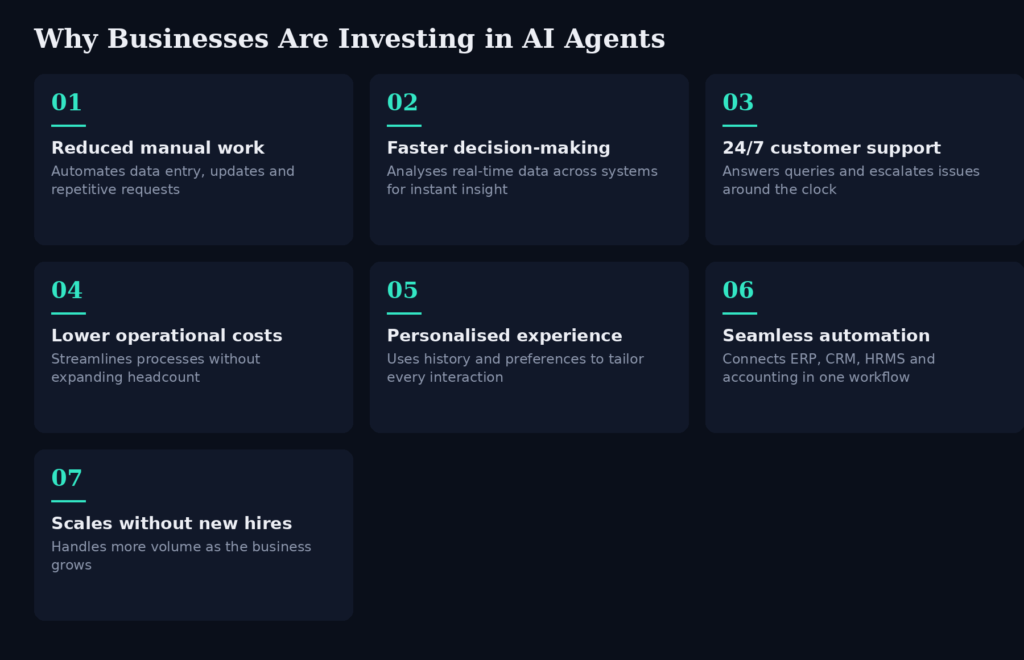
Every growing business reaches a point where manual processes start slowing things down. AI-powered business operations help to remove these bottlenecks by automating complex tasks, connecting business systems and enabling teams to work faster and more efficiently.
Where Traditional Software Still Wins
AI agents are changing the way businesses work, but traditional software still plays an essential role. It is built to deliver consistent, accurate and reliable results, making it the preferred choice for business processes where precision and compliance are critical.
Highly Regulated Industries
Industries such as healthcare, banking, insurance and government operate under strict regulatory standards. Traditional software provides structured workflows, detailed audit trails and reliable data management that support compliance requirements.
Accounting and Financial Systems
Financial operations demand precision. From bookkeeping and payroll to tax reporting and financial audits, accounting software follows predefined rules to minimise errors and maintain data integrity.
Manufacturing and Mission-Critical Operations
Manufacturing systems, production planning and industrial controls depend on stable and predictable processes. In these environments, consistency is often more important than flexibility.
Legacy Enterprise Systems
Many organisations have invested heavily in ERP, CRM and other enterprise platforms. Replacing these systems isn’t always practical. Instead, businesses achieve greater value by extending their capabilities through AI.
Traditional software remains the system of record, while AI agents act as the system of intelligence, helping organisations make better use of the data they already have.
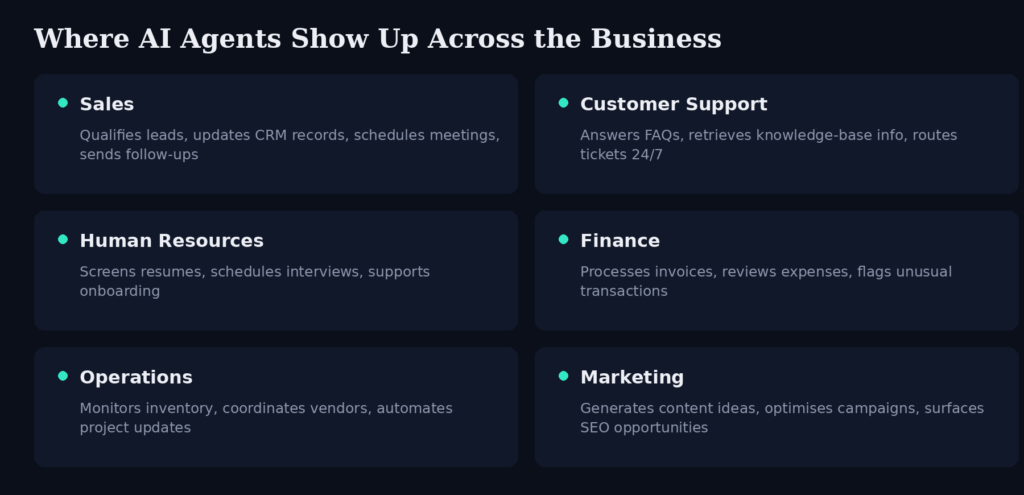
Real Business Use Cases of AI Agents
The true value of AI agents lies in their ability to solve real business challenges. By connecting systems and automating decisions, they help organisations to improve efficiency across multiple departments.
AI Agents + Traditional Software: The Winning Combination
Despite the growing adoption of Agentic AI, businesses aren’t replacing their existing software all at once, nor do they need to. ERP, CRM, accounting platforms and other enterprise systems remain the backbone of daily operations. AI agents simply make them smarter. For example:
- ERP + AI Agent: Predicts inventory shortages, automates purchase requests and streamlines procurement workflows.
- CRM + AI Agent: Qualifies leads, updates customer records and recommends the next best action for sales teams.
- Accounting + AI Agent: Processes invoices, verifies expenses and prepares financial reports faster.
- Email + AI Agent: Prioritises emails, drafts responses and schedules follow-ups automatically.
- Slack or Microsoft Teams + AI Agent: Retrieves business information, creates tasks, answers employee queries and manages approvals without leaving the collaboration platform.
By working alongside existing systems, AI agents help businesses to streamline workflows, improve productivity and maximise the value of their technology investments without disrupting core operations.
How BeanOrbit Helps Businesses Build AI Agents
Building an AI agent isn’t about automating everything. It is about identifying the workflows where intelligence creates the biggest business impact. BeanOrbit works with businesses to uncover high-value AI business solutions, design custom AI agents and integrate them with existing ERP, CRM and enterprise systems. From AI automation for businesses and AI chatbot development to custom software development and enterprise AI solutions, every solution is designed to fit your business and scale with your growth.
The approach is simple: identify the right use cases, design the solution, integrate it with your existing systems and continuously optimise performance. This ensures AI delivers measurable business value without disrupting day-to-day operations.
Future Trends: What Will Businesses Need Beyond 2026?
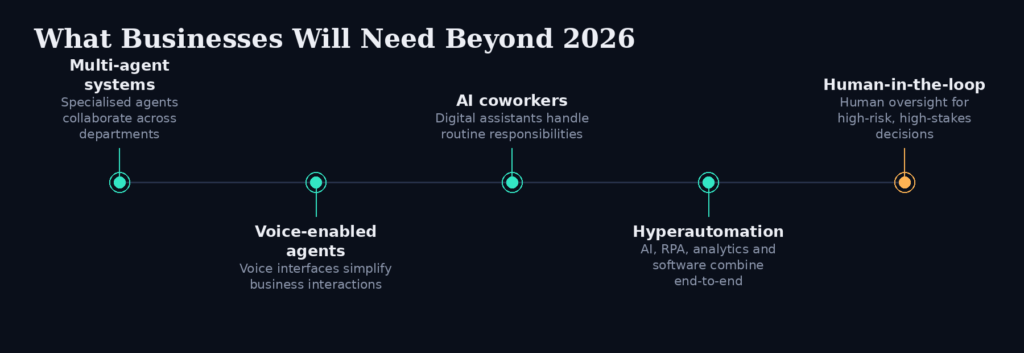
As AI continues to evolve, the organisations that combine intelligent AI agents with reliable business systems will be best positioned to adapt, innovate and grow.
Conclusion
AI agents are changing how businesses operate, but they are not replacing traditional software. While traditional systems continue to provide structure, compliance and reliable data management, AI agents for business add the intelligence needed to automate decisions, streamline workflows and improve operational efficiency.
The future belongs to businesses that combine both technologies strategically. By integrating AI agents with existing ERP, CRM, accounting and collaboration platforms, organisations can unlock greater productivity without rebuilding their entire technology stack. If you are exploring how AI agents can fit into your business, BeanOrbit can help to identify high-impact opportunities and build solutions that deliver measurable results while working efficiently with your existing systems.
FAQs
What are AI agents for business?
AI agents for business are intelligent systems that automate tasks, analyse information, make context-aware decisions and work across multiple business applications with minimal human intervention.
Can AI agents replace traditional software?
No. AI agents complement traditional software by adding intelligence and automation. ERP, CRM and other business systems remain the foundation for managing data and core business processes.
Are AI agents suitable for small businesses?
Yes. AI agents help small and medium-sized businesses automate repetitive tasks, improve customer service and increase productivity without significantly expanding teams.
What industries benefit most from AI agents?
AI agents benefit industries such as healthcare, finance, manufacturing, retail, logistics and professional services by streamlining workflows and improving operational efficiency.
Do AI agents work with existing ERP and CRM systems?
Yes. AI agents can integrate with existing ERP, CRM, HRMS and other enterprise systems to automate workflows, connect business data and improve decision-making.
What’s the difference between AI agents and AI chatbots?
AI chatbots primarily answer questions through conversations, while AI agents can analyse information, make decisions and complete tasks across multiple business systems.
Are AI agents secure for enterprise businesses?
Yes. When implemented with proper governance, role-based access, data encryption and human oversight, AI agents can securely automate business processes while supporting compliance.
How do I start implementing AI agents?
Start by identifying repetitive and high-impact business processes, then integrate AI agents with your existing systems to automate workflows and deliver measurable business value.

Ajay Mon K S is the Founder & CEO of BeanOrbit International LLP, an AI-driven software company. With over seven years of experience, he leads the company's vision and business growth.
